topads

Showing posts with label Car Review. Show all posts

Monday, August 1, 2011

2012 BMW Performance Edition Review

2012 BMW Performance Edition
2012 BMW Performance Edition Review  | Building on the sporting looks of the popular 1 Series Sports Hatch, the 1 Series Performance Edition comes with M aerodynamic bodystyling, dark chrome 18-inch M light alloy wheels, High-gloss Shadowline exterior trim, dark chrome exhaust tailpipe and dark line rear lights.

Enhancing its sporty driving style is the addition of M Sport Suspension, while sport seats with Royal Blue stitching, M Sport multi-function leather steering wheel and gearshift leaver, floor mats with Royal Blue piping and London 2012 exterior badges complete the sporty look. Available on the 116i, 116d and 118d three- and five-door models, the BMW 1 Series Performance Edition costs just £1,500 more than the equivalent ES model, representing a saving for customers of £1,725. Prices start at £19,530 OTR for a BMW 116i Performance Edition three-door.
2012 BMW Performance Edition
The BMW 3 Series Saloon is also getting a Performance Edition revision. Available on the 118i and 118d, the BMW 3 Series Performance Edition will gain an M aerodynamic body kit, M sport multi-function leather steering wheel, sport seats, floor mats with blue piping, 18-inch light alloy wheel, chrome exhaust finisher and London 2012 exterior badges, making the BMW 3 Series a winner in the style race. 
2012 BMW Performance Edition
The BMW 3 Series Performance Edition costs just £500 more than the equivalent 3 Series ES Saloon, saving customers a substantial £2,030. Prices start at £23,195 OTR for the BMW 318i Performance Edition Saloon.The BMW Performance Editions are available in a choice of four colours; Alpine White, Titanium Silver, Bluewater and Black Sapphire, and are on sale now.
2012 BMW Performance Edition


2011 Chevrolet Equinox

2011 Chevrolet Equinox
2011 Chevrolet Equinox Review | The 2011 Chevrolet Equinox to see some changes following the redesign of 2010. This 4-door crossover SUV seats five and reprises LS, 1LT, 2LT and LTZ trim levels. Equinox offers a choice of two engines.


2011 Chevrolet Equinox
Lamp 2011 Chevrolet Equinox
With the horsepower from 182 to 2.4-liter 4-cylinder standard. 264-horsepower 3.0-liter V6 is optional on the 1LT, 2LT and LTZ. New for 2011, the V6 is capable of running on E85 ethanol fuel-blended. A 6-speed automatic is the sole transmission. Front-wheel drive and all-wheel drive offered on all models. Maximum towing capacity is 1,500 pounds with the pound 4-cylinder engine and 3,500 with the V6.
2011 Chevrolet Equinox
Available security features include ABS, traction control, antiskid system, front-side airbags, and curtain-side airbags. The features available include remote engine start, navigation system, wireless cell phone link, DVD entertainment, hard drive for storing digital music files, rearview camera, and power tailgate. Heated front seats are newly standard on the 2LT.


Leather upholstery is optional on 2LT and standard on the LTZ. Chevy Equinox using "MultiFlex" rear seat that can be moved 8 inches fore and rear to better accommodate different storage and passenger needs. The report is based on an evaluation of the 2010 Chevrolet Equinox.

Friday, July 29, 2011

2011 Dodge Charger V6 Review

2011 Dodge Charger V6 Review | When Fiat swept to Chrysler’s rescue, many people—including us—were simultaneously relieved and concerned. We were happy that a major automaker would live on but worried that the savior ended up being an Italian automaker well known for many of the same issues (poor perceived quality, cost-cutting engineering) that got the pentastar company in trouble in the first place.

Regardless of those reservations, there’s no denying the succulent first fruits of the tie-up. For the 2011 model year, nearly every model in the Chrysler, Dodge, and Jeep families received a remarkably effective interior renovation. The Dodge Charger and its Chrysler 300 sibling benefited from a more robust rework, including thorough chassis and powertrain updates and new exterior styling. 2011 Dodge Charger V6, Regarding the 2011 Charger, the interior is particularly pleasing in examples with the no-cost-option black-and-tan interior fitted to our test car. 
Opt for this combination on higher trims levels, and not only are the seats wrapped in soft, caramel-colored leather, but the door panels also get a two-tone treatment that looks particularly rich. The Charger’s carpet and floor mats remain black no matter what the interior color, however, largely defusing one of the most common complaints about lighter cabins, namely, the difficulty of keeping them clean. Elsewhere, the new soft-touch, one-piece dash molding keeps the look clean and uncluttered—although it sounds as hollow as a kettle drum when rapped with a knuckle. 

The instrument panel and the center stack are trimmed in a sort of perforated houndstooth-textured aluminum, a finish that’s far more graceful in person than in description. From the driver’s perspective, the Italians have had an undeniably beneficial influence on the latest Charger. 2011 Dodge Charger V6, In addition to the fantastic reupholstering job, engineers fussed with the suspension. This was as successful as the interior redesign: This beefy, 4113-pound American sedan has a decidedly Bavarian balance of ride comfort and handling, and its predecessor never felt so sophisticated. 

Body control is admirable, the Charger allowing just a few degrees of tilt during aggressive cornering, and neither end overwhelms the other as the 0.82-g limit approaches. Much of the credit for this balance goes to the V-6–powered car’s 51.5/48.5 front-to-rear weight distribution. This Charger was 232 pounds lighter than the V-8 R/T we tested earlier this summer, with 190 of those removed from over the front axle. The Charger’s steering was a similarly welcome surprise. Pleasingly weighted, it responds immediately off-center without being twitchy. There’s not much feedback at the helm, however, but thanks to the 20-inch wheels on our test car, we noted plenty of kickback from midcorner bumps. 

Those 20s also contribute to our one complaint about the Charger’s ride—severe impact harshness—and certainly don’t help combat the alarming brake fade we noted. Our 70-to-0-mph braking distance increased by 20 feet from one stop to the next, with the pedal beginning to soften after one hard stop. The R/T we tested also had 20-inch wheels and had no trouble stopping, thanks to its upgraded brakes. Yes, this is a big sedan, and large-diameter wheels look nice on it, but trust us when we say you probably want smaller ones.

The Pentastar V-6 was welcomed with relief when it debuted for the 2011 model year, but even if it is interplanetary leaps and bounds better than the engine it replaced, it is far from the complete powertrain solution Dodge and Chrysler need. 

The 292-hp 3.6-liter needs to climb high into the tach to get much done, but the five-speed automatic behind it is geared for maximum efficiency and the revs come slowly. The car holds first gear until almost 60 mph, with second stretching nearly to 100. Aggravating as this approach is in around-town driving, it did result in observed fuel economy of 20 mpg. 2011 Dodge Charger V6, At the track, reacting to the 2.8 seconds the Charger needed to accelerate from rest to 30 mph—that’s only 0.1 second quicker than the last Kia Rio we tested—our test driver noted “terrible launch!” on the car’s test sheet. 

The engine pulls noticeably harder above 4500 rpm, like a 1980s turbocharged engine arriving fashionably late. Unfortunately, it also feels noticeably coarser above 4500 and only gets more so toward redline. After 7.2 seconds—and much thrashing—the Charger is going 60 mph, with the quarter-mile passing in 15.7 seconds at 94 mph. We’ve said it before and would very much like not to say it again: The eight-speed automatic Chrysler will introduce soon for these cars cannot come soon enough.

That transmission is a lonely weak spot on the Charger, though. The car is priced competitively, and the menu of optional equipment is long. A base V-6 Charger starts at $26,220; for $4000 more, a Rallye Plus like the one tested here adds Chrysler’s UConnect phone and music integration with an 8.4-inch touchscreen, USB and auxiliary ports, Bluetooth, satellite radio, and a 276-watt amplifier and six speakers. 

It also has remote start, air conditioning, leather seats (heated all around), a leather-wrapped steering wheel and shift knob, 18-inch wheels—up from the base car’s 17s—and heated and cooled cup holders for the front row. None of this stuff would matter in a rally, which is perhaps why the package is called Rallye—an extraneous “e” also does not matter in rallies. The car tested here is doubly Rallye, with the $1195 Rallye Appearance package upping the wheel diameter to 20 inches, the amplifier power to 506 watts, and the speaker count to nine. A body-color spoiler joins the wheels in covering the “Appearance” part of the package name, and this bundle firms up the suspension. Our example then added every additional option but the $50 engine-block heater. 

First up was the $1495 Driver Confidence Group, which nets blind-spot and cross-path detection, parking assist, a backup camera, rain-sensing wipers, and auto-dimming mirrors—but no quiet yet firm affirmations of self. Then came the Driver Convenience Group, which costs $575 and consists of power-adjustable pedals and steering column. An adaptive cruise-control system somewhat strangely bundled with a heated steering wheel goes for $925. Garmin navigation software ran $450, and a sunroof $950. Our car even wore $295 extra-cost paint: Toxic Orange Pearl. (So, yeah, we had an orange Charger. 
Dodge Charger V6
As the author writes this, he realizes he’s wearing an old Dukes of Hazzard T-shirt and “yeehaws” softly to himself.) For this car’s as-tested price of $36,105, though, we’d have to silence our powertrain complaints and crank up the hillbilly hijinks with a 370-hp Hemi R/T; it starts at just over $31,000. The Charger is an interesting summary of the new Chrysler/Dodge under Fiat’s ownership. Much about the car feels very right, with aspects of it—the solid structure, the ride-and-handling balance—approaching excellence. But there is work to do. Dodge has taken one giant leap with this latest Charger, but a small step (or three of them—namely, sixth, seventh, and eighth gears) remains.

Specifications

VEHICLE TYPE: front-engine, rear-wheel-drive, 5-passenger, 4-door sedan
PRICE AS TESTED: $36,105 (base price: $26,220)
ENGINE TYPE: DOHC 24-valve V-6, aluminum block and heads, port fuel injection
Displacement: 220 cu in, 3604 cc
Power (SAE net): 292 hp @ 6350 rpm
Torque (SAE net): 260 lb-ft @ 4800 rpm
TRANSMISSION: 5-speed automatic with manual shifting mode
DIMENSIONS:
Wheelbase: 120.2 in Length: 199.9 in
Width: 75.0 in Height: 58.4 in
Curb weight: 4113 lb
C/D TEST RESULTS:
Zero to 60 mph: 7.2 sec
Zero to 100 mph: 18.2 sec
Street start, 5–60 mph: 7.7 sec
Top gear, 30–50 mph: 3.7 sec
Top gear, 50–70 mph: 5.3 sec
Standing ¼-mile: 15.7 sec @ 94 mph
Top speed (governor limited): 120 mph
Braking, 70–0 mph: 178 ft
Roadholding, 300-ft-dia skidpad: 0.82 g
FUEL ECONOMY:
EPA city/highway driving: 18/27 mpg
C/D observed: 20 mpg

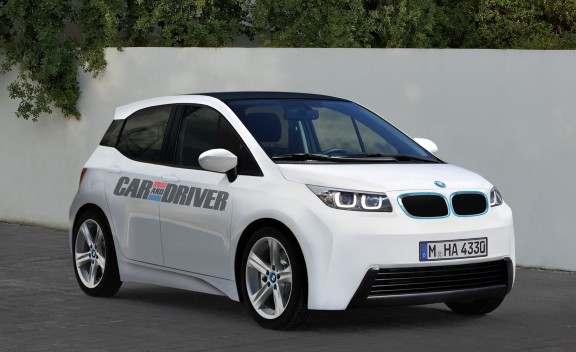
BMW i3 Concept

BMW i3 Concept | BMW has been hyping up its “Megacity Vehicle” for a couple of years now, and despite teasers about innovative tech features and full carbon-fiber body structures, we’ve withheld judgment, even when we spied one in the wild over the winter. But as of now, the shroud of mystery has been lifted about all the details except how the thing actually drives. Like a BMW? Like nothing before it? Maybe both?


BMW i3 Concept, The i3’s story begins with its LifeDrive architecture. According to BMW, experience with the Mini E and BMW ActiveE (the electric 1-series coupe) has proven that creating an electric car out of a structure designed to house an internal-combustion engine results in wasteful excess weight and imperfect packaging. As a result, the i3 (as well as the i8 sports car also being announced now) is made up of two separate modules. 

BMW i3 Concept, The “Drive” portion houses a large array of lithium-ion batteries, plus the suspension, transmission, and electric motor. For a low center of gravity, all of these heavy components are low to the ground, with the batteries spread within the wheelbase for optimal handling. The main structure is all aluminum, with an additional aluminum barrier around the batteries for crashworthiness. The “Life” module sits atop the drive components and houses passengers and luggage. As BMW has already announced, this structure consists of carbon-fiber reinforced plastic, or CFRP, a first for any vehicle this side of a few exotic supercars. While the aluminum Drive module weighs 30 percent less than a similar steel structure, the weight reduction in the CFRP Life module is closer to 50 percent. As a whole, the i3 weighs in at 2756 pounds, according to BMW

When speaking about the safety of CFRP, the company points to Formula 1 cockpits as proof of security. While metals require large crumple zones, carbon can be designed with special deformation elements that result in large amounts of energy being consumed in a very small space. A further benefit of the LifeDrive architecture is the deletion of a driveshaft tunnel, allowing more space to be dedicated to the cabin. BMW says each set of seats (front and rear) is connected so that every passenger can leave from one side in a tight parking space, but we think someone at the company just really digs bench seats. 
There’s approximately seven cubic feet of space left over in the rear for luggage, as well as a small compartment up front where the gas engine would usually be for stowing a charging cord or other small items. Back inside the Drive structure, the i3 uses an electric motor that’s 40 percent more compact than that of a Mini E, allowing it to fit right above the rear axle that it powers through a one-speed transmission. Yes, one speed. That means the car will never shift on its way up to a computer-limited top speed of 93 mph, which BMW has determined to be the point at which the batteries drain too quickly. The company says the i3 will run 0 to 60 mph in 7.9 seconds. In terms of passing power, accelerating from 50 to 75 mph should take just six seconds.

Peak power is 125 kW, or 170 hp, and 184 lb-ft of torque. Range is estimated at 80–100 miles, and a standard charge will take about six hours. With a special high-speed charger, the i3 is said to be capable of reaching an 80 percent charge in just an hour, meaning medium-range drives can be done with just a long coffee break in the middle. But wait, there’s more, as the infomercial folks might say. Feedback from Mini E showed that 90 percent of drivers are content with a driving range of under 100 miles, but for the outlying minority, BMW has (somewhat surprisingly) decided to offer the i3 with an optional range extender. 
The company is mum on details for the time being, simply saying it’s a “small, very smooth-running and quiet gas engine” that drives a generator, both located alongside the electric motor on the rear axle. Sounds like perhaps BMW is borrowing the idea of using a Wankel rotary from Audi’s A1 E-Tron concept car. The engine meets strict SULEV standards and features auto stop-start capabilities. Among the i3’s other energy-saving details are familiar concepts like the “air curtain” first seen on the updated 2011 1-series, which smoothes airflow around the front wheels, as well as narrow drag-reducing tires. Like the accelerator in a Tesla Roadster, the i3’s long pedal is tuned so that the car will still coast if the driver lifts just slightly, while lifting entirely off the pedal will engage regenerative braking based on pedal position. BMW predicts this will allow the brake pedal to go untouched 75 percent of the time.

Beyond that, a button-activated Eco Pro mode changes throttle response so that the same pedal travel delivers less power. In this mode, speed is capped anywhere between 56 and 74 mph, and climate-control output is reduced. However, because the batteries use the climate system to stay at an operating temperature of 68 degrees, the system always remains running to some extent. Eco Pro can extend range by as much as 20 percent. Truly distressed drivers will be able to fall back on Eco Pro +, a mode that shuts down daytime running lights and any other non-vital energy drains, limits climate control functions to a minimum, caps speed at 56 mph, and tells the driver to get bent when he dives into the accelerator. Oh brave new world, with such vehicles in it. Design-wise, you can judge for yourself whether the i3 is a hip little car, but it certainly looks futuristic. The rear doors open up rearward, and the layering of white panels over a black and clear layer is meant to reference the car’s division of Life and Drive components. 

Both “i” cars get a BMW roundel with a blue ring around the outside and blue accents on the grilles and side sills. “Stream flow,” which describes the C-pillar’s exposed glass section defined by lines converging like air streaks in a wind tunnel, is the Hofmeister Kink of BMW i. Our first look inside the cabin, it appears, will have to wait until later. The i3 is still in its concept stage—we’ll finally see it in person this fall at the Frankfurt auto show—so some minor details could still change before its launch in calendar year 2013. We expect it’ll also be some time before we know more about how much the thing will cost. But for now, we must say BMW has our attention. Do you want to try BMW i3 Concept ??

Poke and Prod a 2013 Chevrolet Malibu Interior and Find Lots of Squish and Understated Splash

2013 Chevrolet Malibu
Poke and Prod a 2013 Chevrolet Malibu Interior and Find Lots of Squish and Understated Splash | Chevrolet pulled the sheets off of its 2013 Malibu sedan at this past April’s New York auto show, but it wasn’t until yesterday that we were able to examine the car’s insides. Chevrolet had previously supplied a few press shots of the interior, and the production-intent version is largely the same, with the placement of a few buttons being the only significant change. Our first impressions of the final interior design and materials are positive. Relative to the current-gen Malibu (one was on hand at the press event), the shapes and forms flow together more cohesively and it’s a little more geometric in design.
The window sills and upper portions of the doors and dashboard are crafted from nicely grained soft-touch material, while the padded armrests and styled door inserts come in stitched leather or cloth—the final coverings weren’t on hand for our judgment, however. 
As for spaciousness, the 2013 Malibu’s rear-seat legroom does seem to have taken a hit relative to the current model’s as a result of the 2013 ‘Bu’s 4.5-inch reduction in wheelbase, but it’s still fairly roomy. The fake wood lining the armrests, center stack, and steering wheel is rendered in what Chevy calls a “more modern” pattern, eschewing traditional wood graining and burling, but it really just looks like faux zebra hide slathered in several coats of shellac. It’s the only major misstep, and is standard on LT and LTZ trims; only the base LS is spared. 
A Chevy representative acknowledged that the design team would have preferred a low-gloss finish, but customer feedback indicated Malibu buyers liked shiny better. Too bad. Moving beyond the chintzy “wood,” the Malibu’s interior features classy, blue ambient lighting and sparingly applied chromed plastic. The plastics are all nicely finished, and panel gaps are tight and consistent—bearing in mind that these were specially prepped prototypes—and the switchgear moved with well-damped precision. The Chevrolet MyLink touch screen had sharp graphics and a quick-reacting interface, and a brief demo showed that it appears to be much more straightforward than Ford’s fussy MyFord Touch system. Chevrolet laid out what to expect from the three trim levels at launch, and even the base LS interior is rather attractive, despite being available only in basic black. The LT and LTZ trims will offer three interior color schemes paired with the simulated wood; the LT offers the choice of leather upholstery or cloth seats with vinyl bolsters, while the LTZ is leather only. If you order a Malibu LT or LTZ with what Chevy calls a “fashion” color scheme, your leather seats get snazzy contrasting piping like the car in our photos. The 2013 Malibu will go on sale early next year, by which point we should be able to report whether we like driving the car as much as we did sitting in it.

Sunday, July 24, 2011

2012 Nissan Versa Review and Image


2012 Nissan Versa Review and Image | Great news for all US based car lovers. The 2012 Nissan Versa is ready to hit the US auto market. Fresh new rate has been fixed for the US buyers. Today at a Press Conference the Company officially announced its new 2012 Nissan Versa price that has been finalized for the US market. The fresh 2012 Nissan Versa for the US customers is the modified version of the already existing Versa which is available in UK market. Now the brand new car with finer modifications made according to the taste of the US car lovers will be available shortly. Upgraded features, great style available at amazing rate, all has been fixed for the 2012 Nissan Versa edition.


According to the makers, this 2012 Nissan Versa model is the upgraded second generation edition has the lowest M. S. R.P in United States. This beginner’s model is equipped with a 1.6 liter capacity engine with 5 speed non automatic transmission. This model is priced at 10,990 USD. This entry level model also includes other features like, an air conditioning system, a 6 way changeable seating arrangement for the car driver and an all new infotaiment system with AM/ FM/ CD/Aux musical box.

Among the other available models are available in as follows, the 1.6 SV and the 1.6 SV is starting at a price of 12, 7560 USD. The all new US edition is also available at 14,560 USD depending on the power puffed equipments of the car. 2012 Nissan Versa also offers an 1.8 SL CVT edition at a rate of 15,560 USD.This 1.6 liter CVT sedan is so manufactured, that it should return about 33mpg in a collective cycle. The 2012 Nissan Versa is scheduled to reach the US car dealers within the first half of the moth of August.

Leave comment for 2012 Nissan Versa.

Friday, July 22, 2011

2011 Volvo XC60 Review Review, Specs, Image and Price

2011 Volvo XC60 Review Review, Specs, Image and Price|  is a crossover car that has a strong engine and no longer need to be questioned. Volvo XC60 has been much altered, especially in 2011. Changes in terms of power  has increased and the model  is only a few changes. With a distinctive exterior model  and modern cabin make 2011 Volvo XC60 is a crossover of the most luxurious and stylish. XC60 will meet every requirement for the buyer. To know more clearly how the 2011 Volvo XC60 specifications  let us explain the review below.


2011 Volvo XC60 has a 4-level trim levels: 3.2, 3.2 R-Design, T6 and T6 R-Design.For Volvo XC60 3.2 comes with 17 inch alloy wheels, roof rails, auto-dimming rearview mirror, a power driver seat with memory functions, cruise control, Bluetooth, steering-wheel audio controls and an eight-speaker sound system with a CD player , an auxiliary audio jack and an iPod / USB audio interface, satellite radio, HD radio.And for the Volvo XC60 T6 adds 18-inch wheels, a turbocharged engine, all-wheel drive, power passenger seat and leather upholstery.Volvo XC60 R-Design complete with 20 inch wheels, adaptive xenon headlights, a panoramic sunroof, sport-tuned suspension and steering, privacy glass and special styling elements inside and out.

2011 Volvo XC60
3.2 and 3.2 R-Design will use the 3.2-liter engine, 6-inline which will produce 240-horsepower and 236-lb-ft of torque. 2011 Volvo XC60, also offers a version of this engine squeaky clean That meets PZEV emissions certification, its rated at 230-horsepower.

2011 Volvo XC60
AWD T6 and T6 R-Design models, using a 3.0-liter turbocharged engine, inline-6, and will produce 300-horsepower and 325-lb-ft-torque.

2011 Volvo XC60 All use a 6-speed automatic with manual shift control. EPA received the 18-mpg city/25 mpg highway and 21 mpg combined for the XC60 3.2 FWD, while the T6 model drops to a less-impressive 17/22/19. do you want To try 2011 Volvo XC60??

Thursday, July 21, 2011

2011 Aston Martin Vantage V8 Review and Info


2011 Aston Martin Vantage V8 Review and Info | Wheelsandmore has rolled out a sports car that screams elegance. The latest to make an entry in the Vantage series is the beautifully designed Aston Martin Vantage V8. The vehicle can equally boast of power, intelligence and grace. Quite a package! Clad in modernization, this classy form proudly possesses a naturally aspirated 4.2 liter V8 engine, and has the power of 460 horses molded into one! A torque of 369 lb-ft is what this beauty can do!


2011 Aston Martin Vantage V8, When speeding at 290 kilometers per hour, you can rest assure that this monstress on wheels will grab quite a few eyeballs.Years of excellent service and top notch designs and now the Aston Martin Vantage V8 shows yet again the technical superiority of german tuning in Wheelsandmore and their flawless eye for beauty.

The front and rear wheels are 9.0×21 and 11.0×21 respectively, well fitted with tyres measuring 255/20/21 in the front and 295/25/21 at the rear. The suspension kit wheelsandmore used is of excellent quality and have been designed by the specialists at KW. The glimmering convertible has been gifted the benefits of a 200 cell sports catalyst and a valve controlled exhaust system to perfection.

2011 Aston Martin Vantage V8 Available as a coupe which is a delight for all those who seek sleekness in cars and an adventurous roadster for the free birds who prefer to fly open top, the new additions to the Vantage V8 series shows beauty which is almost aggressive and very few would be able to resist such temptation. As all Aston Martins come, this one too carries a hefty price tag for all who can well afford the astounding luxury and comfort of this newbie.

Small and smart, this car can be a sighted as a clever example of how the best things in life come in small packages! Do you want to try 2011 Aston Martin Vantage V8?

Wednesday, July 20, 2011

2012 Ford Mustang GT Blue Angels Edition Review and Info


2012 Ford Mustang GT Blue Angels Edition Review and Info | Based on the 2012 Ford Mustang GT, the Ford “Blue Angels” Mustang pays tribute to 100 years of naval aviation, which will be celebrated all week at AirVenture 2011 as part of the show’s Tier 1 event status from the U.S. Navy tied to its yearlong Centennial of Naval Aviation festivities. 

2012 Ford Mustang GT Blue Angels Edition will be on display inside the Ford Hangar throughout EAA AirVenture.Based on the 2012 Ford Mustang GT, the Ford “Blue Angels” Mustang pays tribute to 100 years of naval aviation, which will be celebrated all week at AirVenture 2011 as part of the show’s Tier 1 event status from the U.S. Navy tied to its yearlong Centennial of Naval Aviation festivities. The Ford Mustang GT Blue Angels Edition will be on display inside the Ford Hangar throughout EAA AirVenture.


2012 Ford Mustang GT Blue Angels Edition , The exterior of Ford’s “Blue Angels” Mustang GT was inspired by the acclaimed naval aviation performance demonstration team and the F-18 Hornet aircraft it flies. The car’s custom rear spoiler’s vertical tailfins, the “screaming yellow” gloss accents, inclusion of the Blue Angels script and crest all are drawn from the Navy aircraft. The unique chrome blue paint, courtesy of Creations n’ Chrome, is unlike anything available on a production vehicle anywhere in the world. Additional unique details of the “Blue Angels” Mustang include cluster graphics, performance gauges, navigation screen images, safety belt fabric, instrument panel appliqués, rear seat-delete and cross-brace, Blue Angels script in the illuminated sill plates and puddle lamps that project jet images when the doors open.

2012 Ford Mustang GT Blue Angels Edition , Under the hood, the Ford Mustang GT Blue Angels is all performance with a Ford Racing supercharged 5.0-liter V8 engine producing 624 horsepower. The Ford Racing components also include a handling pack, performance exhaust and racetrack brakes.

Monday, July 18, 2011

2012 Audi TT RS Review and Image

2012 Audi TT RS Review and Image - The Audi TT RS is powered by the award-winning 2.5 liter turbocharged five-cylinder TFSI engine that generates 360 hp and 343 lb-ft of torque between 1,650 and 5,400 rpm for power on demand. The engine is mated to a six-speed manual transmission and quattro® all-wheel drive is standard. An automatic transmission is not available for the TT RS. The Audi TT RS accelerates from 0 – 60 mph in only 4.1 seconds, making it the fastest in its class.


The Audi TT RS features exclusive design elements denoting its special place at the top of the TT model line. The high gloss black diamond-patterned Singleframe® grille and large front air inlets give notice of the vehicles performance, as does the fixed rear wing spoiler that provides increased down force. Oval exhaust pipes, rear diffuser, unique 19″ rotor wheels, prominent body sills and exterior mirror housings in matte aluminum finish round out the RS-specific design elements.

The interior of the Audi TT RS also features RS-exclusive appointments, such as the contoured 3-spoke sport multifunction steering wheel, aluminum door sills with the RS logo, and RS-specific interior door handles. Other interior features include 10-way power sport front seats with three-step heating, leather seat coverings, brushed aluminum interior inlays, and available LED ambient lighting. The 2012 Audi TT RS goes on sale this summer and will be priced from $56,850.